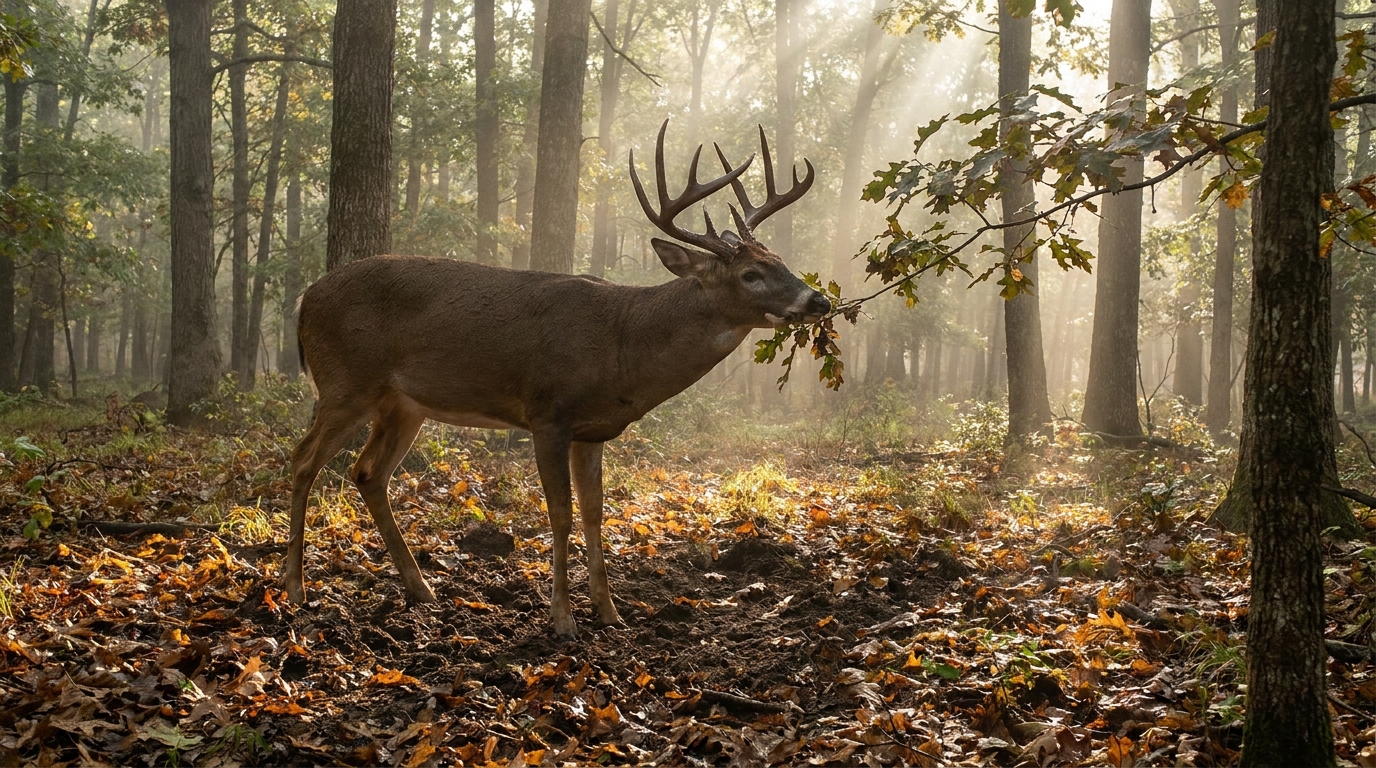
Most hunters put mock scrapes out in October. By then, bucks are checking scrapes almost entirely at night.
Pull card data from any scrape camera across the October rut buildup and you'll see the pattern yourself. Daylight hits cluster in September. Then hunting pressure climbs, temperatures drop, and the bucks that were visiting the scrape at 8 a.m. in early October shift to 11 p.m., 1 a.m., 3 a.m. You're left looking at pictures of headgear you'll never shoot.
Start a mock scrape in late July or early August and you're working with a different set of conditions. Bucks in velvet are relaxed, daylight-active, and curious about anything new in their core area. They haven't been pressured since January. A licking branch with the right scent placed in early August will have three or four bucks checking it within a week. That inventory becomes your pre-season scouting data — those same bucks, now carrying hard antlers in September, already have a habit at your scrape before you've ever pulled a boot on.
The Licking Branch Does the Real Work
Most hunters focus on the pawed-up dirt circle. The dirt matters, but the licking branch overhead is the actual communication point. Bucks deposit scent from three glands onto the branch: the preorbital gland (the pit at the corner of the eye), the forehead gland, and the nasal gland. Does use it too. The branch is a community bulletin board; the dirt circle is just confirmation that something stood here.
This changes how you should think about setup. A licking branch with no ground work underneath will still pull deer consistently. A bare dirt circle with no branch overhead gets ignored.
Find a naturally overhanging limb along a trail and that's your first-choice location. When you're building from scratch, cut a branch from a nearby oak — oak bark holds scent well and bucks seem to prefer the texture for rubbing their foreheads — and zip-tie it to a trunk at chest height, roughly 4.5 to 5 feet off the ground. Leave a couple inches of broken tip dangling. That ragged end is what bucks grab with their mouth and work their forehead into.
Rubber gloves, always. Human palm sweat on the branch suppresses daylight visits from mature bucks for two weeks or more.
Three Locations That Actually Produce Daylight Encounters
Where you set a scrape determines whether it functions as a scouting tool or a hunting tool. A scrape that bucks visit at 2 a.m. tells you deer are in the area. It doesn't help you shoot one.
Inside pinch points, not at them. A gap in a fenceline, a saddle between ridges, a strip of timber connecting two woodlots — these are corridors deer flow through, but mature bucks learn fast that open pinch points mean exposure. Put your mock scrape 40–60 yards inside the timber from the funnel, where deer have cover on multiple sides. Set your stand or saddle between the scrape and the pinch, and you've got a buck stopping in a place where he feels comfortable doing it.
On the downwind edge of a bedding area. Mature bucks stage downwind of bedding areas before entering or exiting, scent-checking for anything wrong. A scrape positioned 80–100 yards downwind of a bedding thicket — with your stand between the scrape and the escape cover — creates a natural stop during that late-afternoon staging window. This is especially productive on October evenings when bucks begin pushing into pre-rut movement patterns.
Along doe travel routes in mid-October. By mid-October, territorial scraping fades and bucks start following does. A mock scrape on an established doe trail between a food source and bedding becomes a curiosity stop. "Who's been here?" is a question every passing buck will want to answer. That pause is your shooting window.
Avoid field edges, wide trail intersections, and anything without cover within 30 yards. Mature bucks will hit exposed scrapes, but only at night.
What You Actually Need
Keep it simple. The list gets padded in most guides because people are selling kits.
- Rubber gloves — before touching anything on-site
- A licking branch (live, oak if possible, roughly thumb-thick, chest-height)
- Interdigital scent for the ground — the scent from between a deer's hooves; signals a deer walked through here
- Preorbital gland scent for the branch — the specific gland deer deposit on the branch in the wild; using doe urine or generic "deer scent" on the branch does not replicate how scrapes actually communicate
- A stick or small rake to clear bare dirt in a 3-foot circle
- Rubber-soled boots you've deodorized, or knee-high rubber waders
The gland-specific scents are where most hunters shortcut and pay for it. Conquest Scents makes dedicated preorbital and interdigital products formulated for these two separate applications, which matters because the branch and the dirt serve entirely different biological functions in how deer read a scrape. A combined "deer scent" applied everywhere muddles the signal.
The accessories category carries scent products and attractants that rotate on sale, especially in late summer when retailers clear inventory before the season rush. Worth checking before buying anything at retail.
Scent Strategy by Phase
July through August: Interdigital on the ground, preorbital on the branch. No doe scent. You want to communicate "a deer was here" without triggering any breeding or competitive response. Bucks in velvet respond to social curiosity. Estrus in August is biologically off-calendar and deer read it as wrong.
September through early October: Add a few drops of buck urine to the ground scrape on each refresh. This introduces territorial tension — a competing buck's scent motivates resident bucks to register themselves at the site. Light application, every week or two, is enough to keep the scrape active without overwhelming it.
Mid-October through the rut: Switch the ground scrape to doe estrus. Bucks are shifting attention from territory to does. A scrape smelling like a receptive doe near your stand is exactly the situation you want a buck to stop and stand in.
Approach the site from downwind on every visit, refresh scent, and leave. Every unnecessary approach teaches the local deer that this location is associated with people.
Running Trail Cameras on Scrapes
A mock scrape is your best camera location on any property. Bucks come in from a predictable angle, stop with their nose at the branch, then stand over the dirt — full frontal shots, which is what you need to identify and age individual animals.
Position the camera 10–15 feet from the scrape at roughly a buck's chest height, angled slightly downward. Most hunters mount cameras too high and end up with skylined antler silhouettes and no face detail. The lower angle fixes that.
Minimize your check visits. Every approach deposits human scent and trains deer to associate the location with pressure. A cellular camera solves the problem — images go to your phone without you ever walking in. For scrape locations specifically, the remote access is worth the cost premium over SD-card cameras. The accessories section carries cellular trail camera options that come on sale periodically.
The Saddle Hunter's Specific Advantage
Saddle hunters and lightweight treestand hunters have one edge over fixed-stand setups when it comes to mock scrapes: you can pick the tree you want to hunt first, then locate the scrape where the terrain calls for it. You're not organizing a season around where you dropped a scrape in August.
This enables a better process. In July, identify your best candidate trees — wind direction, approach routes, sight lines. For each candidate, find the optimal place nearby to build a scrape. Mark both on onX, build the scrapes in August, set cameras, and leave. By the time season opens, you're choosing between multiple proven locations based on current wind and live camera data rather than guessing which site is working.
Run-and-gun hunters can also build a quick scrape as part of new-setup reconnaissance: go in a week before you plan to hunt, hang the branch, scuff the dirt, add scent, hang a camera. Come back to hunt with information instead of hope.
Saddle hardware, lineman belts, and treestand accessories occasionally drop in price during the late-summer window before the pre-season rush drives things back up.
What Kills Results
Bare hands on the licking branch. Once is enough to reduce mature buck daylight visits for two or more weeks. Gloves on from the moment you arrive at the site.
Locations where deer can't feel safe stopping. Wide trails, field edges, anything with no quick escape cover nearby. Exposed scrapes go nocturnal every time, without exception.
Too many site visits. Walking in every few days to refresh scent and pull cards trains the local deer to associate that spot with human pressure. Two visits per month maximum during the season, with cellular cameras filling the gap.
Same scent on both the branch and the ground. They serve entirely different functions in how deer communicate through scrapes. The correct scent in the correct location is what makes the system work.
---
Start in summer. Build a system of two or three scrapes feeding toward your best stand tree. Let the camera inventory accumulate before you ever sit in that location.
By October 1st, when most hunters are hammering their first scrape into the October dirt, you'll have face shots and time stamps on every buck working that corridor — and a location those deer already consider part of their normal routine.