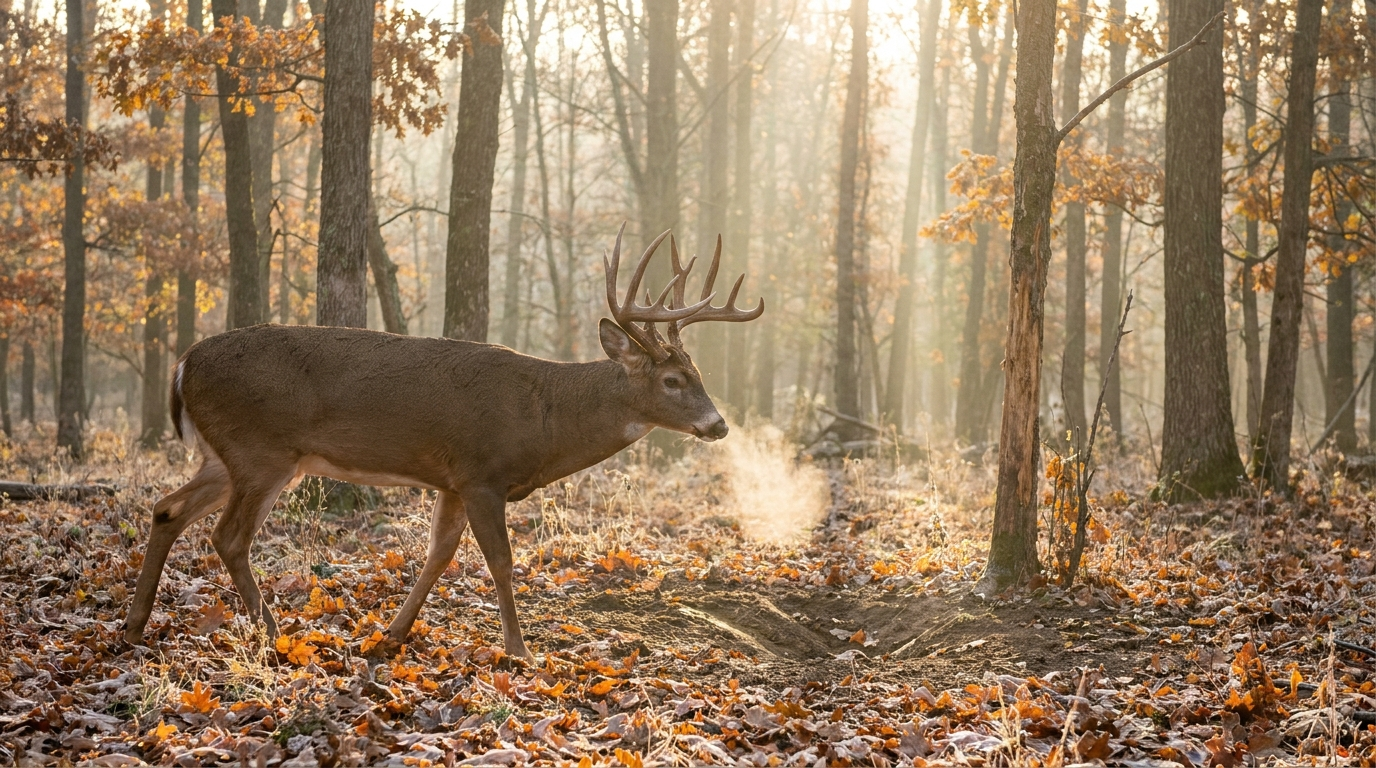
Most hunters treat the whitetail rut like a single two-week event. They save vacation for November, pick a scrape line they've watched all October, and sit hard until something walks through. The problem: deer behavior shifts almost weekly from mid-October through early December, and the stand location that was right on Halloween is dead wrong by November 7th.
Five phases. Five different stand setups. Here's how to match your position to what bucks are actually doing.
Before the phases, get your timing right. Peak breeding in the northern Midwest (Wisconsin, Michigan, Minnesota) runs November 10–20. Kansas and Missouri, November 12–18. East Texas, October. Mississippi and Alabama, January. Northern Florida, February.
Fetal-aging data from 2,561 does documented a six-week shift across the whitetail's north-south range. Most rut-hunting content gives you advice without anchoring it to your region. Everything below is calibrated for the northern Midwest. Shift it 2–4 weeks later if you're hunting the Deep South.
Pre-Rut (Mid–Late October): The Last Time Patterns Hold
Bucks in October are still predictable in broad strokes. They're hitting primary scrapes on trail intersections and field edges, working the same corridors on a loose schedule. This is the last window where your trail camera history and e-scouting translate directly into stand placement.
Get between bedding and food, downwind of the trail you expect him to cross. On hillside terrain, thermals handle most of your scent management. Evening thermals pull downhill, so your scent rolls toward the valley. Set up on the upper half of the slope so you're not blowing scent back into the bedding above you. Morning thermals reverse and pull uphill, so set up low, below the trail you're watching.
One thing most articles get wrong about scrape hunting: don't set up over the scrape itself. Bucks approach their own scrapes from downwind. Position yourself 20–30 yards downwind of the scrape, in the direction he'll come from before he reaches it. You'll intercept more deer and your scent stays out of the approach lane.
Light, social grunt calls work in pre-rut. Tending grunts and aggressive rattling aren't effective yet. A short contact grunt is enough to stop a walking buck and give you a shot.
The expiration date on pre-rut setups is real. Once the first does cycle (October 28–31 in the northern Midwest), buck behavior shifts within days. The scrape you watched for three weeks will go cold almost overnight.
The Seeking Phase (Late October–Early November): Terrain Beats Sign
When bucks start cruising between doe bedding areas, your cameras will go from showing a predictable shooter at 6 AM to capturing 40 different bucks at random midday hours. That's not bad news. It's a signal to change setups.
GPS collar research on 33 bucks found every one of them made at least one major excursion outside their core home range during breeding season. Average daily movement hit 4.6 miles. You cannot ambush a deer covering that kind of ground by waiting on a specific scrape.
This is when terrain funnels earn their reputation. A ridgeline saddle (a low point between two high spots) pinches cruising bucks the same way a swamp edge does in flat agricultural country. During the seeking phase, I'd rather hang in a terrain funnel with zero fresh sign than sit over a month of cold scrape history.
Three terrain setups that consistently produce in this window:
- Inside corners where standing timber meets thick cover (cruising bucks hug these transitions, and inside corners concentrate them)
- Creek crossings between two large timber blocks, especially in agricultural country
- Narrow strips of cover connecting bigger woods. Even a 50-yard connector strip becomes a buck highway in the seeking phase.
Saddle hunters have a specific advantage here. When bucks are laying down fresh sign on different trails every 24 hours, you can hang in a new tree the same afternoon you decide your morning location was wrong. That mobility isn't optional in this phase — it's the whole game.
Peak Rut (November 1–12): Hunt the Doe, Not the Sign
GPS tracking data reveals a meaningful split among mature bucks: roughly a third are "mobile" bucks covering home ranges averaging 16,000+ acres, while two-thirds are "sedentary" bucks staying within 900 acres all season. One tracked buck covered 200 miles over 22 days. Another made an 18-mile round-trip excursion, recovered, then made an 11-mile excursion 10 days later.
Your stand strategy for peak rut should start by asking which type of buck you're hunting. A sedentary buck can be somewhat patterned even during breeding. A mobile buck passing through your area might not return for weeks.
Either way: during peak breeding, your scrape is irrelevant. Once a buck finds a receptive doe, he stays with her for 24–72 hours. He is not checking scrapes. Hunters who consistently kill mature bucks during peak rut are hunting doe concentration areas.
Find where does bed. In agricultural areas, look for the thickest, most undisturbed timber within half a mile of a major food source. In forested country, look for south-facing slopes with dense screening cover. Does prefer thermal bedding areas that hold warmth on cold nights. Set up on the downwind side of doe bedding, with shooting lanes covering the ground between that cover and the nearest food.
Midday movement during peak rut is real and consistently underestimated. Bucks moving from one doe to the next cover ground between 10 AM and 2 PM with regularity you won't see in October. I've killed two mature bucks between 11 AM and 1 PM during the first two weeks of November. Both came out of doe bedding cover in the middle of the day. Pack food and stay in your stand.
Rattling works in this phase. Short sequences (5–10 seconds of light grinding, not sustained combat) pull in cruising bucks already primed for aggression. Loud, prolonged rattling more often causes deer to hang up at the edge of cover or blow out entirely.
Lockdown (November 8–14): The Phase That Tests Your Patience
Lockdown is when you sit four hours and see nothing. A buck and doe pair have bedded within 100 yards of each other and neither is moving until she cycles out. Hunting pressure thins the woods in this window because most hunters give up and go home.
The hunters who stay are hunting doe bedding. The ones who kill deer during lockdown have figured out the access problem that almost no hunting content addresses: how to enter a doe-bedding setup without blowing it.
Getting in without alerting deer requires morning-only entry when thermals pull uphill and away from your approach, a separate trail in vs. out, and air-drying outer layers before the sit to reduce residual odor. You get one clean intrusion into that setup every two or three days before does learn your access route.
If you don't have a specific doe-bedding location dialed, hunt transition edges between two different vegetation types where does move between feeding and bedding. Slower, but you're not burning your best locations.
Post-Rut (November 15–December): The Window Most Hunters Leave Behind
By mid-November, bucks are depleted. They've burned through fat reserves and have one priority: food. For two to three weeks after peak breeding, a mature buck gets almost as predictable as he was in early October.
Stand placement post-rut is straightforward. Get as close to the best available food as you can while staying downwind of where deer enter. Standing corn and soybeans if you have access. Late-season food plots (brassicas hold nutrition through hard frosts). Mast crop areas with adjacent heavy bedding cover. Unlike October, bucks are hitting these sources with urgency.
Cold fronts in late November and December trigger the best daylight movement of the post-rut period. A 20°F temperature drop over 24 hours can bring a shooter to a food source at 4:30 PM that hasn't shown on camera in daylight since October. Be in your stand before the front arrives, not after.
The Second Rut: December Is Worth Hunting
Doe fawns and unbred does cycle in December, triggering a genuine second rut. Most hunting content calls it subtle or mythical. It's neither. It's compressed and hyper-local, which means it needs a completely different approach from November.
Second rut bucks aren't covering 4.6 miles per day. They're working small circuits around known doe concentrations. All-day funnel sits that produce in November won't work in December. Short morning sits near doe bedding and afternoon sits on food-to-bedding routes are the play. Soft doe bleats near known bedding can pull in a buck working a tight circuit. Save the rattling for November.
Stand vs. Saddle: Which Tool Fits Which Phase
Fixed hang-on stands with permanent hardware are best suited to phases where you know where deer are moving: pre-rut corridors, doe-bedding morning sits you've earned through fall scouting, late-season food sources confirmed on camera.
Mobile saddle systems earn their value during the seeking and peak rut phases, when fresh sign appears in a different location every 24 hours. The ability to hang in a new tree same-day is the difference between a productive sit and watching a cold scrape. The tradeoff is noise — a saddle on sticks in 20°F weather makes sounds a fixed stand doesn't. Practice your cold-weather setup before November, not during it.
Browse current deals on treestands, saddle systems, trail cameras, and all-season whitetail gear at Treestand Saver.