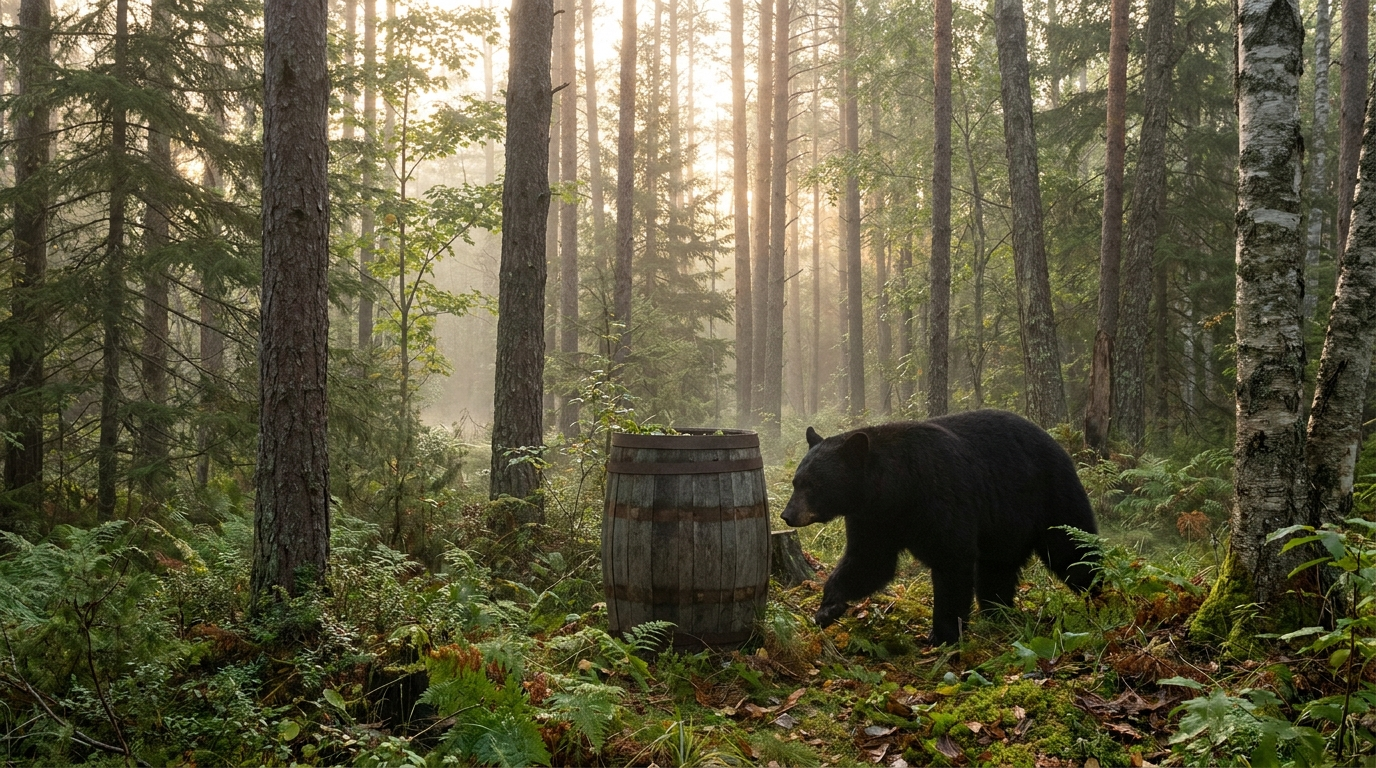
You set up a bait barrel in early July, and for the first week and a half it just sits there. Maybe a raccoon gets into it overnight. Nothing more. Then one morning the lid's fifty yards off in the brush, the barrel's on its side, and there's a track the size of your palm pressed into the mud beside it. That's the site working. Getting to that point, and keeping it working through opening morning, has almost nothing to do with the bait itself and almost everything to do with where you put it, how you approach it, and how disciplined you are once a stand goes up.
Baiting for black bear isn't legal everywhere, and where it is, the rules on how much bait, what kind, and how close to a road or dwelling vary by state and sometimes by unit. Confirm your state's current regulations before you haul in a single bucket. What follows assumes you're hunting somewhere baiting is legal and you've already checked the specifics.
Site selection comes before stand selection
Most first-time bear baiters pick a spot because it's easy to get to. That's backwards. A site a bear has to work to find and feel safe visiting produces better than a site fifty yards off a two-track where every truck that passes pushes scent and noise through the area.
Look for thick cover within a hundred yards or so. Bears want to approach and retreat without crossing open ground, and a site tucked against a clearcut edge, a swamp margin, or a stand of young timber gets hit harder than one sitting in a park-like stand of mature hardwoods. Terrain that funnels wind the same direction most evenings, whether that's a ridge, a drainage, or a field edge, lets you plan a stand location once instead of fighting variable thermals all season. Water nearby helps too, since bears drink often in summer heat and a site within a few hundred yards of a creek or seep gets checked more frequently than one requiring a longer detour to reach. And your own access route needs to avoid crossing the bait's approach zone. If you have to walk through where bears are entering the site just to reach your stand, you're leaving scent exactly where it matters most.
Set the stand or ground blind up at the same time you establish the bait, not weeks later. Bears already associate a certain amount of disturbance with that spot from the initial setup. Coming back later to hang a stand causes a second disruption on top of the first, and it's the second one that tends to shut a site down for a week or more.
Wind decides where the stand goes, not the other way around
Black bears hunt with their nose first. They can pick up scent from well over half a mile out under the right conditions, and they overwhelmingly approach bait from downwind, circling to scent-check the site before committing to the last stretch. That single fact should drive your stand placement more than any other variable.
Put your stand so the prevailing wind carries your scent away from the direction bears are most likely to approach from, not just away from the bait itself. In practice that usually means studying the terrain for a few days before you ever climb up, noting which way smoke or dust drifts in the evening, which is when most bait sites get worked.
Distance matters too. Fifteen to twenty-five yards from the bait is the range most experienced baiters settle on. Close enough for a clean bow shot, far enough that your scent cone and any small movement in the stand don't blow up the site before a bear commits. Height matters less than it does for whitetails. Bears rarely look up, so a stand in the 12- to 18-foot range works fine and keeps the climb quieter than something hung higher.
Stand discipline is the whole game
A bear bait site can produce for weeks if you handle it right, or go cold in three days if you don't. The difference is almost entirely discipline once you're in the stand.
Wash hunting clothes in scent-free detergent and store them away from gas cans, coolers, and anything else with a strong smell. Rubber boots hold scent less than leather, and they clean up easier after a muddy approach. None of this eliminates your scent (nothing does), but it buys you margin on evenings when the wind isn't perfect.
Once you're in the stand, sit still and stay quiet longer than feels necessary. Bears often hang up at fifty or sixty yards, working the wind, before they ever show themselves fully. Movement or noise at that stage — shifting your weight, unzipping a pocket, checking a phone — is enough to turn a committed bear away for good. Give a site more time than your patience wants to. A bear that beds up nearby and doesn't show for two sits often shows on the third if nothing spooked it in the meantime.
The safety side nobody skips on paper and everybody skips in practice
A full-body harness with a lifeline, worn from the moment your feet leave the ground until they're back on it, is not optional. Haul your bow or rifle up separately with a rope. Climbing with a weapon in hand is still one of the more common ways treestand hunters get hurt, and it has nothing to do with the animal you're after.
The animal-specific risk is different from deer hunting: check the tree and the trees around it before you climb. A sow with cubs will sometimes send them straight up the nearest tree if she's nervous, and if that tree is yours, you're now sharing a stand with animals that can climb faster than you can descend. If a bear approaches your stand directly rather than the bait (which is rare but does happen, usually out of curiosity rather than aggression), make noise, wave, and let it know you're human. Most leave immediately once they register that.
Gear that earns its place at a bait site
You don't need much specialized gear to bait bear effectively, but a few categories punch above their weight. A solid pair of binoculars lets you glass a bait site from a distant ridge or truck window without ever pushing scent into the area, which is useful for pattern-checking activity before you commit to a sit, and it's worth a look through the current optics deals before season. For the actual sit, scent-control-oriented layers from brands like Sitka and Kryptek show up regularly in the current jackets deals, and midweight insulation from either brand doubles well for early-morning stand sits before summer heat sets in.
For hauling bait, tools, and a trail camera in and out without turning the approach into a bushwhack, a frame pack built for real weight beats a daypack. Forloh's pack lineup is built with exactly that kind of load-hauling in mind.
A trail camera on the bait site itself is close to mandatory. It tells you what's actually visiting and when, without you having to sit there burning scent on evenings that would've been a bust anyway. The same card-checking discipline covered in Treestand Saver's guide to running trail cameras without bumping deer applies just as directly to bear sites, maybe more, since bears investigate a camera far more aggressively than whitetails do.
Don't treat the bait site like a set-and-forget
The biggest mistake isn't picking the wrong spot. It's treating the site like a vending machine: refill it, walk away, come back a week later expecting the same bears to still be interested. Consistency matters more than volume. A site refreshed on a predictable schedule, approached the same clean way every time, with a stand that respects the wind, builds a pattern bears settle into. Break that pattern with a sloppy approach or an inconsistent refill schedule and you're starting over.
If you're setting up out of a saddle rather than a fixed stand for the flexibility to reposition as wind shifts through the summer, the fundamentals in Treestand Saver's saddle hunting starter guide translate directly. The platform changes; the wind math doesn't.
Get the site right before the season, and the stand work in September takes care of itself. Check the current gear deals on Treestand Saver while you're setting up.