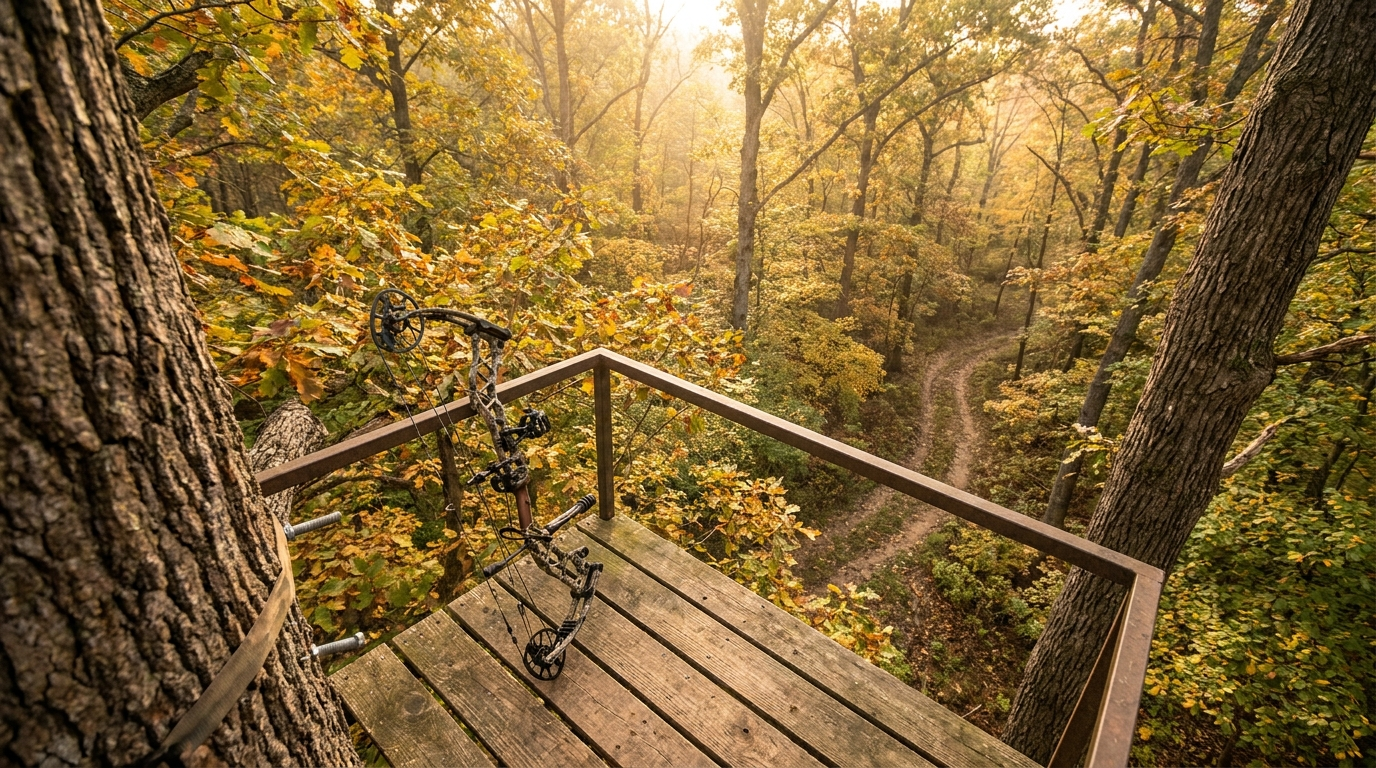
Whitetail archery season opens in under eight weeks across most of the Midwest and South, and the shot you've been grooving in the backyard all summer is not the shot you're going to get in October. Flat-range groups mean almost nothing fifteen to twenty-five feet up a tree with the ground falling away underneath you. The angle changes everything about how the arrow flies, how your body has to move to make the shot, and where you need to hold the pin. Most guys find this out the hard way, watching a good buck walk off unscathed after an arrow sailed high over its back.
The fix isn't more range time at seven yards on flat dirt.
It's practicing the actual geometry you'll be shooting in.
Why elevated shots miss high
Gravity pulls an arrow down over the length of its flight. That's true whether you're shooting flat or at an angle, but the angle changes how much of your line-of-sight distance actually counts toward the drop. A deer standing forty yards from the base of your tree, measured in a straight line to your eye, might only be thirty yards away on the horizontal plane that gravity is actually working against. Shoot your 40-yard pin at that animal and the arrow goes over its back, because you gave it forty yards of gravity compensation for a shot that only needed thirty.
This is the single most common miss from a treestand or saddle, and it's almost entirely a practice problem, not an equipment problem. Modern angle-compensating rangefinders will do the horizontal-distance math for you in the field — Leupold, Vortex, and Sig Sauer all build this into their hunting rangefinders now — but a rangefinder doesn't fix your form. You still have to know where to hold, and that only comes from practicing at real angles, not from trusting a number on a screen you've never actually shot to.
Keep the T, bend at the waist
The instinct when aiming down at something is to drop your bow arm. Don't. Dropping the arm independently breaks the relationship between your eye, your peep, and the string, and it changes your anchor point without you noticing. Your face still lands in the same spot on the string, but the sight picture is now wrong because the arm did something the rest of your body didn't.
Draw the way you would on level ground — full T-form, shoulders and bow arm forming a straight line perpendicular to your spine — then bend at the waist to bring the sight down onto the target. Your torso does the work. Your arms stay locked in the same relationship to your shoulders the whole time. It feels unnatural for about the first twenty reps and then it's just how you shoot.
A cheap bubble level clipped to your sight housing will catch the other half of this problem: bow torque. Standing in a stand or hanging in a saddle, most people cant the bow slightly without feeling it, especially when they're twisted around to take a quartering shot. A few degrees of cant at twenty yards is a few inches of left-right miss. Check the level every single practice rep until it's automatic.
The saddle adds its own problem
Everything above applies whether you're in a hang-on stand, a climber, or a saddle. Saddle hunters have one more wrinkle: the strong-side window. If you're right-handed, drawing and aiming into the 20-to-30-degree arc directly to your right — across your body, across the tether and bridge — is awkward in a way a treestand with a fixed platform simply isn't. You either bring the bow across the bridge rope and rotate your hips into it, or you stand up on a small foot platform and turn your whole body to square up. Neither move is instinctive the first few times you try it.
Practice that specific shot on purpose. Hang your saddle at hunting height in the yard, or borrow ten minutes on a friend's setup, and force yourself through that strong-side rotation until it stops feeling like a wrestling match. If it's still ugly after real practice, that's useful information too — some hunters simply reduce their maximum shot distance on that side rather than force a low-percentage shot they haven't grooved.
Build a practice routine that actually transfers
Shooting a 3D target in your backyard from a stepladder is not glamorous, but it's the single best way to close the gap between summer groups and October misses.
- Start low. Ten to twelve feet is enough to introduce a real angle without the added stress of height. Get the mechanics right here before you go higher.
- Work up to hunting height. Fifteen to twenty-five feet covers most stand and saddle setups. If you have access to a ladder stand, deck, or elevated platform, use it. A step stool in the yard works if that's all you've got — the angle math doesn't care what's holding you up.
- Shoot your actual hunting setup. Same release, same broadheads if you can spare a few for practice, same clothing bulk you'll be wearing in October. A bulky jacket changes your anchor point more than people expect.
- Cut your effective range. Most bowhunters should be shooting ten to fifteen yards closer than their flat-ground max when they're up a tree and rushed. If you're a confident 40-yard shooter on the ground, treat 25 to 30 as your ceiling from elevation until you've logged real reps proving otherwise.
- Practice the draw, not just the release. Half the misses at elevation happen because the draw itself was off-balance or noisy, not because the aim was bad. Practice standing, kneeling, and — if you're a saddle hunter — hanging in the harness.
Where to actually hold the pin
Once your form is right, the aiming adjustment is straightforward: on steep angled shots inside twenty yards, hold one to three inches low. Aim for the lower third of the vitals rather than dead center — this splits the difference between the angle compensation and the fact that a startled animal is more likely to duck than jump straight up. The steeper the angle and the longer the shot, the more you hold low. Past twenty-five yards at a real angle, that adjustment can be the difference between a double-lung hit and a gut shot, so this is exactly the kind of thing you want to have already worked out on a 3D target before it matters on a live animal.
Gear worth checking before the season opens
None of this works if your equipment is fighting you. Broadhead flight can open up more than field points at extreme angles if your bow isn't tuned clean, so if you're shooting fixed blades, get a few flying true at your actual practice angles before the season, not just at seven yards on the flat range. A release that's inconsistent shows up worse at elevation, where you've already got more variables working against you — check yours for wear before you need it.
Boots matter here too, in a way people overlook. You're going to be climbing in and out of a stand or saddle repeatedly through a summer practice routine, and the boots you break in now are the boots that won't blister you three weeks into the season. Crispi's current boot lineup runs deep discounts right now, worth a look if yours are worn through. If you need a rangefinder with real angle compensation for practice and the field alike, current optics deals are worth checking before you spend full retail. And if you're rebuilding a lighter layering system for sweaty summer practice sessions that transitions into cooler October sits, Kryptek's current pants deals are worth a look — the fit changes how comfortable you are bending at the waist fifty times in an afternoon. A release aid that's starting to slip or a bubble level you don't already own are both worth grabbing from the current accessories deals before opener, not during the week of.
If you're new to saddle hunting entirely and haven't built your kit yet, our saddle hunting starter guide walks through the platform, sticks, and tether setup before you get to the shooting part. And if climbing safety hasn't been part of your prep, it should be — the treestand safety guide covers the checks worth doing before you're fifteen feet up with a bow in your hand.
Eight weeks is enough time to fix this if you start now. It's not enough time if you wait until the week before opener and try to cram it in. Get your ladder, your target, and your actual hunting gear out in the yard, and put in the reps that transfer. Everything else on Treestand Saver is built around getting you into the stand or saddle better prepared than the season before.